We've been enthralled by the recent reintroduction of the extraordinary PS-3300 polyphonic, cabinet-based, semi-modular synthesizer, first introduced by Korg in 1977. However, few people were aware of its existence and even fewer ever got to have one. When you think of classic Korg synths there's something else that tends to come to mind, something far less glamorous, far more punk and adorably unruly, and that would be the MS-20.
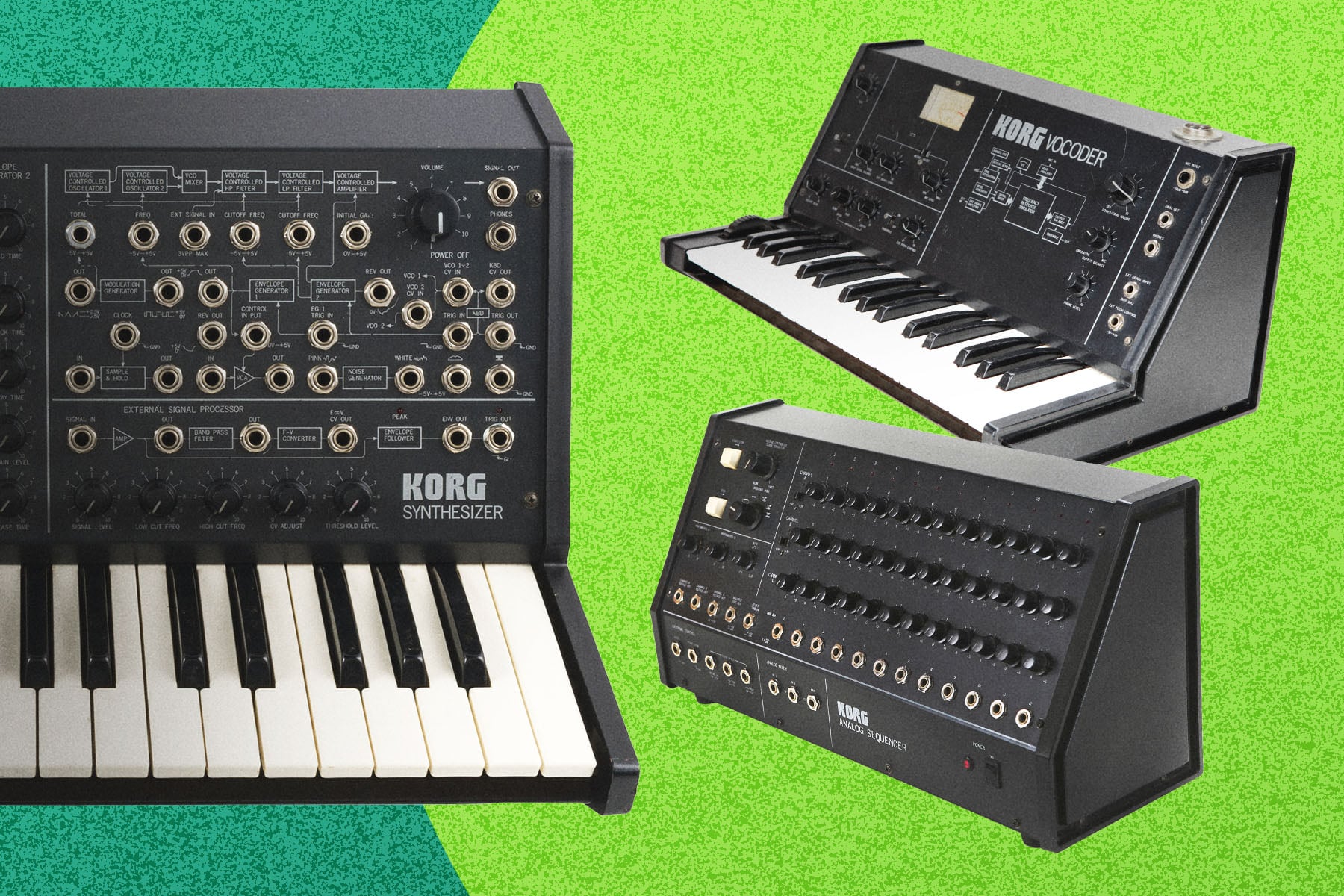
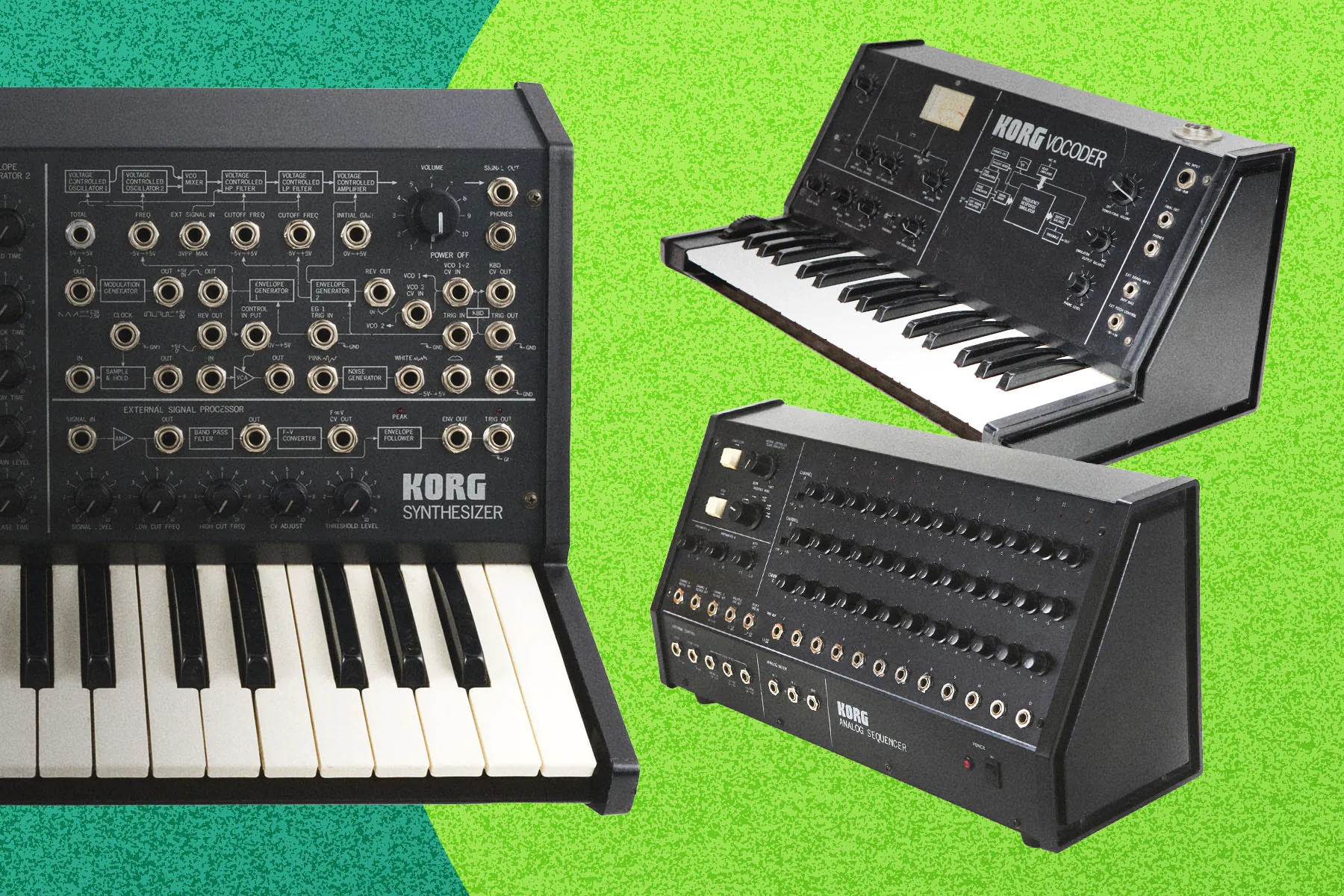
In 1978, Korg released a family of simpler synths and associated machines that drew inspiration and technology from the PS series but packaged it up in a more accessible and ultimately successful form.
Korg MS-10 Semi-Modular Synthesizer
You can't get much simpler than a single-oscillator monosynth, but the MS-10 owned its basic specification with a certain amount of arrogance. The upright form was very striking, very much like classic cabinet modular synths, but the black chassis and black wood ends marked it out as something very different. It was an attitude that would run through all these boxes.
×
The MS-10 had one VCO capable of producing triangle, sawtooth, pulse/square waves, or white noise. There was pulse-width modulation that could push the square through a tiny pulse and into non-existence. It had an octave switch from 4' to 32' and a tuning knob with a full octave range. From there we head into what would become a quite infamous filter. It's a simple 12dB/oct lowpass affair but one that would scream in self-oscillation without any trouble at all. If Moog filters were considered fat and juicy, then the MS-10 could be called thin and gnarly. Perhaps more importantly, it gave the synth a very distinct character.
For modulation we have a regular ADSR but with a Hold stage that holds the sustain level for a period of time once you've released the key before going to the release stage. There's one LFO (or "Modulation Generator," as Korg likes to call it), which offers a variable shape from shallow saw, to triangle to steep saw. The keyboard is a little short at one and a half octaves, and you get a little wheel controller that can be patched into whatever you'd like to control, and that, of course, is where things get really interesting.
×
On the right of the front panel, along with some useful flow diagrams, is the patch bay. These used full-sized quarter-inch jacks and gave this little synth a surprising amount of versatility. You have outputs for the LFO with the triangle/saw combination and square wave, an extra noise generator, inverted envelope, and the wheel from the keyboard. These can be patched into the oscillator frequency, filter cutoff, pulse width, and amplifier gain. There are trigger inputs and outputs that can collaborate with the envelope, as well as an external input for running something through the filter.
Overall, the MS-10 was cheap, brittle, and full of quirky sounds that would be a fantastic introduction to synthesis.
Korg MS-20 Semi-Modular Synthesizer
It is the MS-20 that gets all the attention. Adding a second oscillator really does elevate a monosynth to a whole other level. Along with the delicious detuning options, you also got some variation in wave shape. VCO1 had the same triangle, saw, square/pulse, and noise as the MS-10 but while there's a control to vary the pulse width, there's no opportunity to modulate it. The second VCO had sawtooth, square, a narrow pulse and ring modulation options for some dual-waveform clanging.
In addition to the Korg-35 circuit lowpass filter, Korg added a highpass filter in series. Both have their own Peak (resonance) controls that are prone to spinning out into self-oscillation. Korg did calm the filters down a bit in later models, but thankfully they still retained much of the venom.
×
In the modulation department, we now have two envelopes. One of them was the same as the MS-10 with the interesting Hold stage, but the other had three stages, Delay, Attack, Release, which was commonly used with the LFO to add vibrato after the initial sound or for increasing modulation over time. We still have the one LFO with its slightly odd shaping control, and a pink and white noise generator with a Sample & Hold circuit, which takes us into that patch bay.
The MS-20 patchbay looks much more complex and confusing than the MS-10. But somewhere in there, you've got a good selection of inputs and outputs that give you everything you'd expect, including inverted versions of both envelopes, S&H, and triggers. However, we have an extra section called the External Signal Processor (ESP), which is very reminiscent of the input on the ARP 2600. The ESP input is amplified, passes through a bandpass filter, and can be used as an envelope follower, trigger source, or even for pitch-to-CV conversion. If you use a very simple input, you can get the MS-20 to follow a tune, but otherwise it's a brilliant source of modulation.
×
The keyboard is expanded to three octaves, and alongside the free-moving mod wheel is a trigger button for triggering sounds without having to play the keys. It feels like a much more substantial instrument than the MS-10.
With the dual-oscillator sound, screaming filters, expanded modulation features, and external sound processing, the MS-20 is a seriously fun and versatile machine. The filter gets a lot of attention in the modular community with various Korg filter clones popping up.
Korg has revisited it a number of times. First in 2004, with software emulation in the first Korg Collection, which offered the bizarre but adorable optional MS-20ic dummy controller. It works in conjunction with the software to give you a believably authentic hardware experience, to the point that you can plug patch cables into the controller's patch bay, and they appear on-screen. It's not compatible with other bits of modular, which does make it somewhat restrictive. Next in 2010, there was an iPad software version. In 2013 we get an actual recreation of the hardware in a slightly smaller form. The Korg MS-20 Mini was also available as a kit to build yourself. In 2015 there was a desktop version of the Mini. Finally, in 2020 Korg released a full-sized replica.
Korg MS-50 Modular Synthesizer Expander
×
Designed as an expander module for the MS-20, the MS-50 doesn't have a keyboard, has only one VCO, but offers a lot of patching and modulation potential. It's also not a semi-modular; there's no hardwired internal signal path, so whatever you wanted to do, you had to patch it directly to and from the module in question. It is, in essence, a Korg modular synthesizer (a truly wild proposition).
The oscillator had simultaneous waveform outputs and two modulation inputs. The filter was just a lowpass with a single input, and modulation for the cutoff. There were two VCAs and two envelopes, one regular ADSR and one with Hold. It also had an Adding Amplifier with three inputs, a Ring Modulator, Sample & Hold, noise generators and the ESP from the MS-20. It had a bunch of utilities that were a very useful addition, like buffered multiples (called Junctions), a divider, a trigger switch, an inverter, a VU meter and a headphone socket.
Korg SQ-10 Sequencer
×
To help with the playing of the three MS synths, Korg introduced a companion sequencer, the SQ-10. It had three rows of 12 knobs giving you three channels of 12-step sequencing. You could link two channels together to give you a single 24-step sequence, which was a useful feature. Otherwise, that was more than enough to run a couple of tunes and some modulation. It was also really good at making wide per-step changes. Consider that with three channels you could use one for pitch, one for moving the filter and another for modulating any other aspect of the sound.
It had 6 playback modes and a duty-cycle-based way to introduce a little bit of swing. Channels A and B featured some portamento to glide between steps. You could start and stop it with a footswitch, utilizing an internal clock which can be modulated—or alternatively, it will respond to an external clock if you want to sync up to other machines.
The SQ-10 with its deceptively simple front panel of knobs brought a lot of musical control to the table. In more recent years, it served as the inspiration for Korg's affordable SQ-1 desktop MIDI/CV sequencer.
Korg VC-10 Vocoder
×
Completing Korg's 1978 musical machines was the VC-10 vocoder. It has a 20-band signal analyzer, a 20-band EQ, a goose neck microphone planted in the top, and an internal, divide-down synthesizer giving each of the 32 keys its own, tunable voice.
Using the microphone, you could modulate the internal synthesizer to produce what we now call classic vocoder tones. You could send in other carrier sounds to be modulated by your voice or indeed other modulators. There was a mix control to balance between the dry carrier (whether synth or external) signal and the vocoded one. You could also add a little bit of Accent Bend to the pitch to mimic the sound of pitch changes in the human voice. At the output there was an Ensemble effect taken from the PS-3100, giving it a surprisingly rich output.
It was cheaper and simpler than any other vocoder around, and was completely self-contained, with the keyboard, synth engine and microphone. It became a popular addition to the range. It is featured prominently in the video for Laurie Anderson's "O Superman," among many other classic works of popular electronic music.
The MS Series in Hindsight
Though that covers the best-known entries in the series, this synthesizer ecosystem also included a handful of boxes that provided some useful utilities. The MS-01 offered an expression-style pedal with a voltage output on one side and an attenuator on the other. MS-04 was another expression-style pedal that expands on the MS-01 with an LFO and CV bend. The MS-02 was a desktop box that would convert the commonly used volts-per-octave pitch format to and from the Hz-per-volt format used by Korg.
The MS-03—perhaps the most interesting of the MS utility boxes—was a desktop version of the MS-20 ESP, allowing for standalone envelope following and pitch-to-control voltage conversion, great for use with synthesizers outside the MS Series lineup.
Korg created a rather magical little synthesizer family in 1978. It was simple enough and affordable enough to find its way into the hands of musicians outside of the studios and who were not necessarily professional. It was a very different approach to the seriousness of many other synth manufacturers. However, it came at the tail-end of the analog monosynth era, and it wasn't long before polyphony and digital control systems changed the nature of synthesizers in the 1980s. It's a testament to the character of the MS-20 that it has remained a sought-after and enjoyable synth long before and throughout the current analog resurgence.






The information below is required for social login
Sign In
Create New Account