Cart
Quantity :
Loading...

 Close Menu
Quantity :

Tom Oberheim found that his love of music harmonized perfectly with his interest in engineering. On paper, he was a physicist and an electronics engineer, but it was his love of jazz that compelled him in 1956 to move to Los Angeles, where he sought out jazz clubs. He took a job at National Cash Register (NCR), which was experimenting with the emerging computer industry, and these machines struck a chord with Tom. Over the next few years, while studying physics part-time at UCLA, he took a few music courses and met trumpet player Don Ellis and keyboard player Joseph Byrd, who was a member of the experimental rock band The United States of America.
Tom has been building hi-fi components and amplifiers since he was a kid and ended up building a P.A. Amp for Don and guitar amps for Joseph's band. Joe had used an early Ring Modulator in some of their music, but when one of the members left, they took it with them. So, the singer, Dorothy Moskowitz, asked Tom if he could build them a new one. At the time, ring modulators were mostly found in modular synthesizers, but Tom found a design in a 1961 issue of Electronics Magazine by Harald Bode that he was able to fashion into a standalone Ring Modulator guitar pedal. He also built one for Don Ellis. Then composer Leonard Rosenman heard about it and wanted to use one on the soundtrack to the 1970 film Beneath the Planet of the Apes.
There was a lot of interest in Tom's strange little box and how well it worked in live performance, and Tom found working with musicians and electronics far more interesting than building computers. In 1969, the Chicago Musical Instruments Company (CMI) expressed an interest, and Tom raised some cash to start up Oberheim Electronics. He produced the Maestro RM-1A for CMI, and followed it up with the Leslie-inspired PS-1 phase shifter, both of which were very successful.
You may wonder what this has to do with the design of the SEM, but it was precisely Tom's association with and enjoyment of working with musicians through CMI that led him down this path into synthesizers. At the 1971 NAMM show, Tom approached Alan R. Pearlman of ARP Instruments and offered his services as ARP's first dealer on the West Coast. Product engineers don't always get to deal with customers, and Tom found himself in a unique position where he could use his engineering skills to respond directly to what customers told him they needed.
In the early 1970s, Tom was working with experimental composer Richard Grayson, designing live performances of electronic music. At the time, everything was monophonic, but Tom had access to the ARP schematics and was able to design a modification for the ARP 2600 to let it play the two oscillators independently. Using two modified 2600s Richard was able to play four-part classical-style music. It wasn't two “voices”, it was just separating the oscillators and then routing them paraphonically through the one filter and VCA. However, it sowed the seeds in Tom’s mind of the possibilities of electronic polyphony.
Next came the 1973 DS-2A digital sequencer, which drew heavily on Tom’s experience as a computer systems engineer. The DS-2A would let you enter a sequence of notes and note durations directly from a synthesizer keyboard and could then play them back through most of the available analog synthesizers of the time. It was a great success and the perfect companion to the ARP 2600. However, it got Tom thinking that maybe the DS-2 could benefit from a simple synthesizer voice of its own.

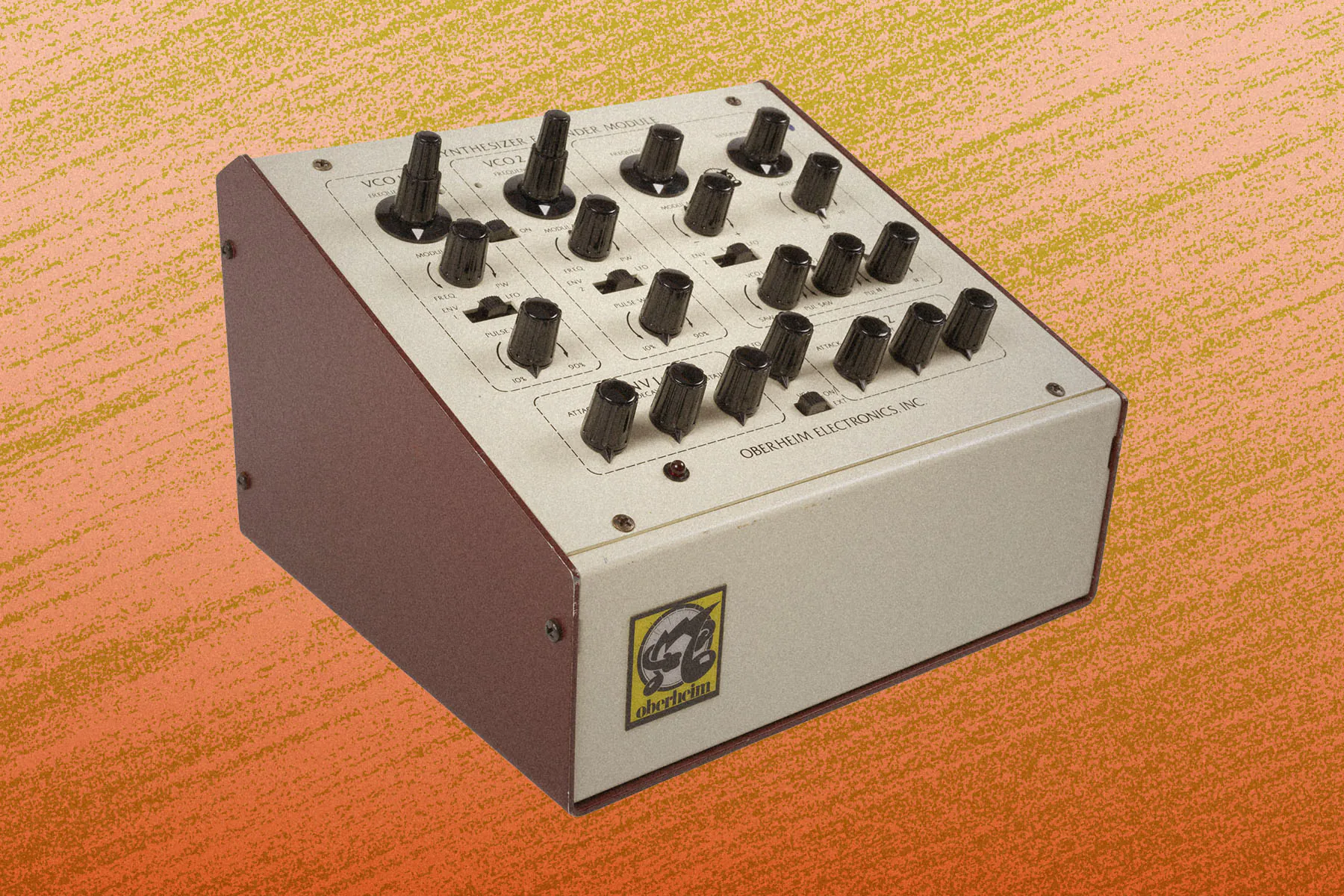
In 1974 Tom released the Synthesizer Expander Module or SEM. It was the first machine Oberheim built that actually made its own sound. In typically collaborative style, Tom saw it as a device that could enhance or fatten up the sound of other synths or as a companion to the DS-2, rather than as a synthesizer in its own right. The SEM was as straightforward as a synth voice could be. It has two oscillators with sawtooth or variable pulse waveforms, a simple LFO, a VCA and two ADR envelope generators. The filter was unusual in that it had a gentler 2-pole slope than the Moog or ARP filters and offered high-pass and band-reject along with the more common low-pass. The filter gave the SEM a discernibly different tone, and the CV connections on the back made it a very adaptable and useful additional voice to any setup.
By this time, polyphony had become a hot topic. When a musician saw a keyboard they wanted to be able to play chords, and it appeared that Moog, Yamaha, Emu and a newcomer Sequential Circuits, were all working on the idea. Tom went back to his experiments with the ARP 2600 and thought that the compact and versatile nature of the SEM synthesizer could be a route to polyphony.
Tom called up Dave Rossum of E-mu, who had had a hand in the design of the SEM, to find out about an innovative digital scanning keyboard they were using with the E-mu Modular System. He then roped together four SEM modules, which could be triggered one after the other, creating a full four voices of polyphony. What made this interesting and different from other attempts at polyphony, such as the Polymoog and Yamaha GX-1, was that each voice was essentially an independent synthesizer with its own controls. This meant that you could set each voice to sound completely different. Other "polyphonic" instruments of the time largely used divide-down topologies, with little voice-to-voice varition possible (as each "voice" shared the same set of panel controls). For a coherent instrument you probably do want the voices to be indistinguishable, but it was this variation that gave the Oberheim Four-Voice (FVS), Two-Voice (TVS) and then Eight-Voice (EVS) its unique allure.
Looking deeper into the Four-Voice, we find that there are other innovations at play. To the left of the keyboard was a module called the Polyphonic Keyboard Controller.

This governed various ways in which the keyboard interacted with the SEMs. The order that the SEMs played with each note could be a continuous cycle 1 through 4, or it could reset to 1 after the last note is released. They could be split into two lots of two SEMs, or one and three directed to the top half or bottom half of the keyboard. You could have a unison mode that played all four SEMs together monophonically or a split unison with two SEMs on each note. The module added portamento that could be assigned to the higher or lower split or the whole keyboard. At the bottom was a master control over all four filter cutoffs and a master tun knob for all the oscillators. These aspects pushed the Four-Voice into a semblance of a complete polyphonic synthesizer instrument, but there was one more module to come that really sealed the deal.
While the FVS was blowing the minds of musicians when it was released in 1975, Tom quickly realised that having to individually program four SEMs didn't make it very friendly for live performance. So, he set about developing a way of expanding the Keyboard Controller to handle more parameters and then storing the settings for recall.

The Polyphonic Synthesizer Programmer was released in 1976 and was an optional module that sat to the left of the Polyphonic Keyboard Controller. It looked a lot like another SEM and gave it a more complete master control over the Four-Voice, although it's nowhere near as intuitive or complete as what we tend to assume. Remember that this is two full years before the arrival of the game-changing Prophet-5 from Sequential Circuits, which is often talked about as being the first "proper" programmable polyphonic synthesizer. The FVS Programmer was undoubtedly an important step along the way, but it essentially dealt with CV offsets to what was on the front panel of each SEM. Therefore, you would still need to start by programming each SEM individually and then use the Programmer controls to offset the original settings. This meant you could absolutely recall up to 16 large variations, but it only handled VCO tuning, VCF cutoff, envelopes, VCF envelope depth, vibrato rate and depth. You couldn't control filter resonance, pulse width, sync, filter modes, LFO rate, modulation depth or sources. However, at the time, it was a complete revelation and gave the Four-Voice the option to behave more like a single synthesizer entity while never losing the possibility of the versatile independent SEM voicings.
The Two Voice (TVS) was based, obviously, on two SEM synthesizers, but had a different feel to the FVS. Two voices of polyphony were only exciting up to the point where you wanted to play a chord. So, the TVS had its own innovations in the shape of a sequencer for each SEM. This became interesting because you could split or layer the SEMs across the keyboard and decide which would be a sequence and which would be played regularly. So, the sound of the TVS became this animated mix of played lines and sequenced lines that followed the transposition of the keyboard. It could, of course, play as two stacked SEMs for unison or two separate melody lines. It was far more compact and felt like a very creative concept.

The Eight-Voice System was the absolute opposite of compact. It took the FVS idea to its natural conclusion by adding another four SEMs in an expansion chassis utilising the same features, control and programmer as the FVS. It was breathtaking, but probably too much for most people to accommodate. I've read that musicians would tend to buy two FVS rather than a single EVS. However, that didn't stop Tom from developing the massive Dual-Manual Eight Voice, which split the eight SEMs into one case and a four-octave and five-octave keyboard into another that then somehow worked together with a single programmer. Only ten were ever built.
For a couple of years Oberheim rode a wave of popularity around successful polyphony. The SEM-based synths were more synthy than the Moog Polymoog, less complex than the Korg PS-3300 and cheaper and more manageable than the Yamaha GX-1. But the arrival in 1978 of the Prophet-5 put pay to all that. The Prophet-5 was lighter, much more portable and was able to store and recall all the settings on the synthesizer using microcontrollers while offering a single, coherent interface. It set the scene for how we would view synthesizers from that point on, and a chunky, multi-synth machine like the FVS or EVS seemed hideously dated in comparison.
I think it would have been inconceivable for Oberheim to do anything but follow the Prophet-5. Tom was always pushing what could be done with the technology and integrated circuits of the time. By the late 1970s microprocessors and computer technology were exploding, and it was a world that Tom was very comfortable with. In 1979, Oberheim released the OB-X. It was capable of up to 8-voice polyphony and fully programmable, like the Prophet-5. It was based on the SEM circuitry, but the shrinking of components and expansion of ICs meant that those eight voices could be housed on cards within a relatively modest-sized machine. Gone, of course, were the individually programmable SEM panels, replaced by a unifying digital control system that offered convenience and common sense. By 1981, Oberheim had moved on from the SEM using a different family of chips for the OB-Xa, and that appeared to be the end of the SEMs story.
I find it really interesting that when Tom returned to synthesizers in 2009 after 20 years of doing other things, the first thing he released was a reissue of the SEM. There's something about the purity and authenticity of that box that speaks to the heart of synthesizer enthusiasts. The SEM filter has been copied countless times and is either cloned or emulated in hundreds of different hardware and software synths and Eurorack modules.
In 2015, he rereleased an updated TVS as the TVS Pro and later in 2021, there was a special edition which featured the Oberheim brand once again as the rights had been returned. Oberheim has now become part of the Focusrite family of brands, which includes Sequential Circuits, with whom they've collaborated on several notable polyphonic synths, including the impressive OB-X8, which features many SEM circuits. There is nothing quite like a SEM, though, and I wonder whether we'll see it in a multi-synth-synth form again.


The information below is required for social login
Sign In
Create New Account