Cart
Quantity :
Loading...

 Close Menu
Quantity :
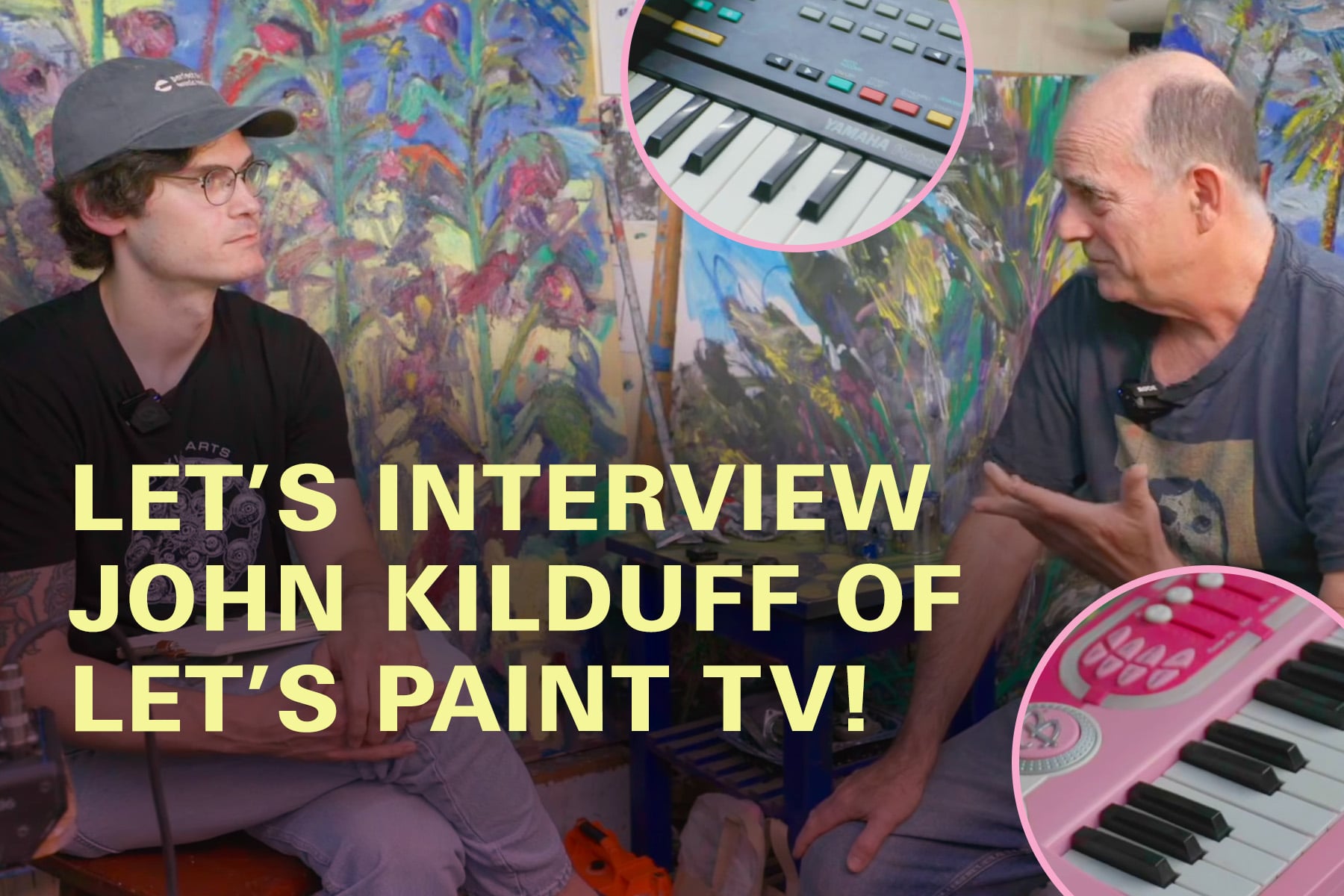
John Kilduff is an LA institution. Originally from Oakland, John made a name for himself in outsider art and performance in the vibrant scene of Los Angeles Public Access television, most notably with his instructional painting show, Let's Paint TV. Operating far outside the conventions of most how-to-paint shows, Let's Paint TV captivated audiences with John's uniquely chaotic but committed approach to art making. Incorporating multitasking into the art making process, John often could be seen simultaneously running on a treadmill, making blended drinks, and much more while working on a painting, all the while taking live phone calls and instructing his audience to fearlessly try, embracing failure while "doing it all".
I found John's work later on when these clips made their way to Youtube, but I can imagine how it must have felt to be flipping channels in those days, passing over Becker re-runs and the home shopping network, and finding yourself suddenly immersed in the fray of a Let's Paint TV episode. Auditory and visual chaos abounds in each entry, and it's likely that first time viewers might be caught in John's headlights, thumbs poised over their remotes, paralyzed with questions that demanded answers. Sooner or later, the chaos becomes a sort of comfort and comedy, and for my money offers one of the most exciting television experiences one could hope for.
Out of breath, covered in blended pineapple and watercolors, John never let up, even while wrangling callers to behave in their short moments of airtime, batting away gangland shout-outs and profane pranksters with the tired persistence of an overworked babysitter. Always presciently attuned to the increasing precarity of modern living, John's committed campaign for doing more, even if you're failing at all of it, offered a sincere message of persistence in the face of the world's unreasonable and unrelenting demands. We laugh alongside John's developing mess, and feel a bit less worried about our own. Suddenly something like art making seems possible—not because John taught you how to paint, but because he taught you to try even when it seems impossible to succeed.
Technologies come and go, and naturally John's days on TV came to a close as public access television lost its already shoddy footing in the American media landscape. A nimble adopter of new media formats, Let's Paint TV moved online to the world of streaming and social media. Over the last few years, John has been developing a new body of work centered around sound performance and improvisational music making, a natural evolution of his work in Lets Paint TV. Combining toy keyboards, drum machines, loopers, and other sonic ephemera, his performances feel like a distillation of the original Let's Paint chaos, bringing together his characteristic calls for creative endurance while the kitsch and camp of keyboard demo songs, preset beats, and sputtering, stammering phrases create a rich bed of frenetic sound.
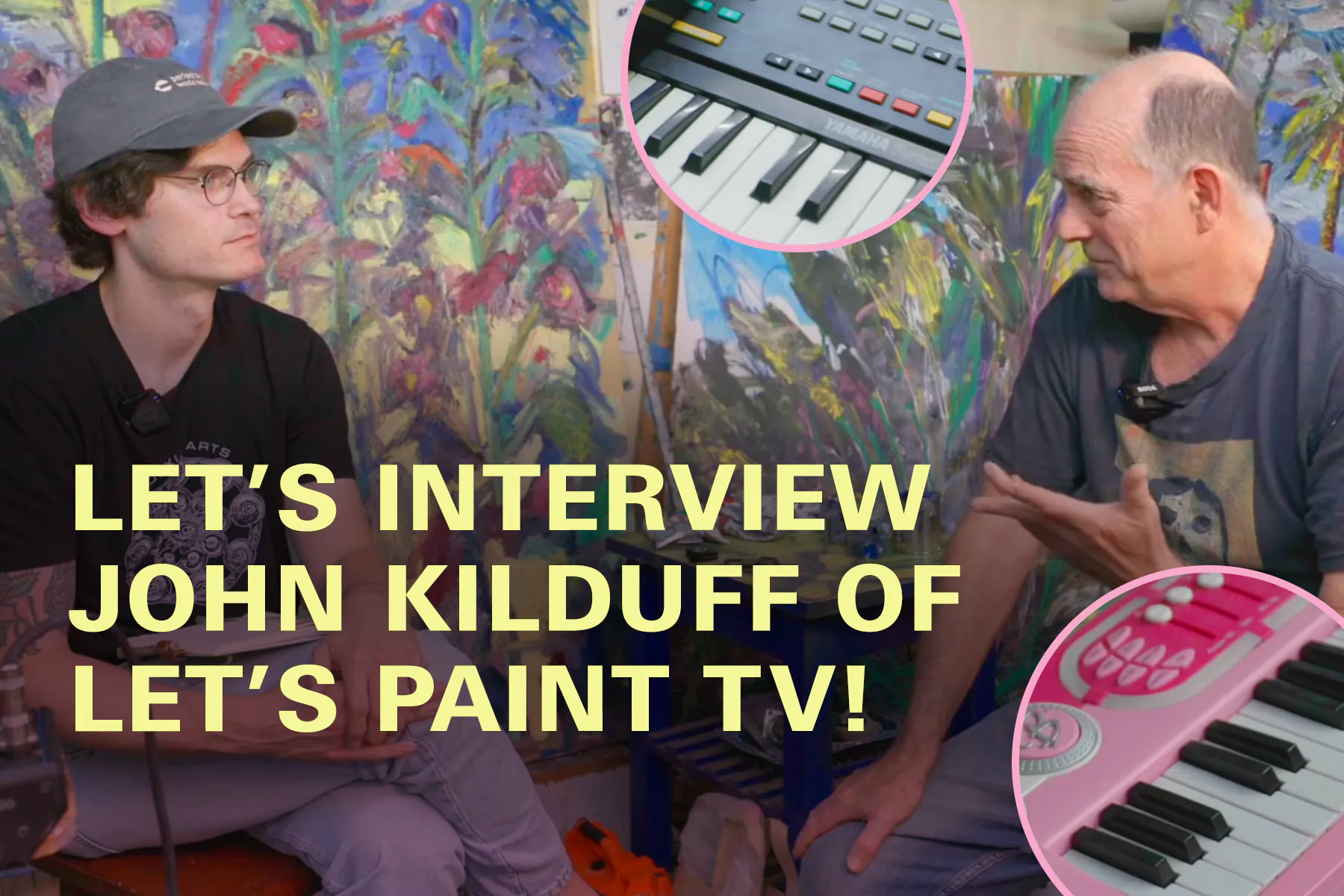
Long time fans of John's creative work with technology in the Let's Paint TV era, we were instantly intrigued by his move into sound performance. It can't be overstated how effortlessly John's performances fit into the worlds of free improvisation music, noise, and performance art, yet his characterful perspective as a champion for creative fearlessness lends his work a unique and unmistakable charm. Catching the first of his recent run of live concerts with Los Angeles free improviser Adam Lion, I couldn't help but ask John for a chance to pick his brain about his work with electronic sound. Graciously, John invited us out to his studio for an extended conversation about his background in art and recent work with music making. Watch and read the full interview video below!
Perfect Circuit: We're here with John Kilduff, Mr. Let's Paint TV himself. Thanks so much for having us in the studio. I really appreciate you sitting down.
John Kilduff: Hello, thanks for coming!
PC: So, you've done a lot of stuff over your career as an artist. You're a painter, performer, Improv comedian to some degree — I was curious about maybe just establishing a little bit of your background in art. We were talking a little before we started about you originally coming to LA in the '80s and going to school for art. What drew you to explore a life doing art? And what led you to that? Did you have early artist experiences?
JK: I mean, I was always interested in that. I took art classes at the local college, an art school up in Oakland. I grew up in Oakland. So I'd take classes at various places, from CCAC, then Piedmont High School adult education. They had all these different woodworking, wood carving, stained glass classes. I took stained glass, and of course watercolor, and painting and life drawing. I took all of those. For me it was fun. And my mom was always willing to get me into a class, basically pay for those classes. So I've always enjoyed that. I've always gravitated to making art. And you know, I think in high school you kind of realize you're not gonna keep doing what you'd been doing. You gotta make a decision, what are you going to do. And I played high school football, and I wasn't going anywhere with that.
PC: What position did you play?
JK: I was an outside linebacker. And a receiver, and the punter. The last year I went both ways. I think in a weird way that childhood athleticism, of playing sports, is still in me.
PC: Yeah, totally. I mean, you could definitely describe a lot of the things you do as athletic to some degree.
JK: Yeah, there is that element for sure. But you realize, I can't even bench 120 pounds or something, so that wasn't going to be it. So I put two and two together: 'I think I'm gonna go to art school', because I really got into the idea of trying to be an artist. And I gravitated to painting. I really got into the whole plein air painting thing, which is where you go outside and paint wherever. And one of the main reasons I got into that was that I wasn't at home, where my mom was constantly going, 'what are you doing'? You know, you're in her domain. So it was always great to be outside, and by painting or making artwork you're not getting in trouble as much. So yeah, it was kind of to stay out of trouble.
So I said, well, let's go to art school. I wasn't really that great at academics, and I wasn't pressured to say, look, you gotta become a doctor. You gotta be a lawyer, or an engineer, because that's where the money's at. No, I was allowed to be an artist. So I went to art school.
PC: Yeah, you went to Otis, finishing up around the end of the '80s?
JK: Right, early '80s. '83 to '87.
PC: And then, coming from Otis, I know later on you obviously got involved with the public access stuff. Through the Jim Berry program, right? The Jim Berry show. And I know you did some work with the Groundlings, the improv troupe?
JK: Yeah, I just took a class.
PC: Was that before the Jim Berry show?
JK: No, no, it was sort of in between, it was during that time. So I started the Jim Berry show in '95, and then it went into 2001, and then I began doing the Let's Paint TV show.
PC: And with Let's Paint, did you always have the idea to merge painting and what you were doing with the public access stuff, was that always in your mind, or did it arrive naturally?
JK: It arrived pretty quick. My very first, maybe one or two shows, were more straight ahead, how to paint in theory, and quickly I realized this is kind of boring. I wanted to do a how-to-paint show in the first place that was not boring, because I had a dislike for all painting shows basically. You name him, of course, Bob Ross. And yeah, I've learned to like Bob Ross to some degree. I mean, but it's still pretty boring ultimately.
PC: It's soothing maybe.
JK: It's soothing, okay, I'll give you that. But it's like elevator music in a way. It's comforting. It's calming, I'll give you that.
PC: Not exactly gripping.
JK: No, not so much. And I didn't care for seeing hordes of people trying to duplicate what they were doing. These are the masses who are watching these programs. Masses, aimlessly watching, or mindlessly watching, in a sense, because they're just duplicating. They're ultimately going to duplicate a Bob Ross painting.
Or there's a woman called Donna Dewberry, she had a whole thing on one-stroke painting, more of a craft painting exercise, you could just do one brush and get these beautiful flower paintings. And I'm like, 'okay...' So I wanted to at least put my spin on it, my take, and after all, that's all it is. As artists, that's all it is, it's just our own personal take.
So you don't want to do what I'm doing. But I think that's kind of why I don't like those shows, because they're not telling you to do what they're doing, but in a sense they are. And a lot of art education is like that. Art professors, when they teach, they'd like you to, even if they don't say it, they'd prefer that you kind of become a devotee of what they're doing, and mimic, and ultimately do what they're doing. Be part of the school of whatever.
PC: Well, I would say Let's Paint, for probably some very obvious reasons, is very different from any other painting show, incorporating the multitasking element, the treadmills, the blended drinks, ping-pong with the invisible man was one of my favorites. Even outside of what was going on onscreen, something that was interesting to me about Let's Paint was even just how it was filmed. There's a lot of video feedback stuff going on. Was that something you brought to Let's Paint, or from working with other people?
JK: It was kind of a wonderful collaboration with the people working at the studio in Eagle Rock. I did most of my shows at the Eagle Rock Cable Access Studio over there. So mainly this one guy named Gus, and Johnny was another guy, they were the workers that would help produce all the different shows for the cable access. They were a team. When I came in, they kind of knew what I'd like to do, so I'm like, let's get the blue screen. Well, we used to call it blue screen.
PC: Yeah, before it was green.
JK: Yeah, it's green now. I grew up with blue screen, so I always say that. Anyways, they knew what I wanted. And it was also wonderful because I encouraged them to explore that, to have fun.
PC: That's great. It's almost like your message was kind of getting out even to the crew itself.
JK: They were having fun. I like to think they enjoyed doing my show, because they had other programs where it was far more uptight and concerned about whatever.
PC: And then, moving on from public access, when the station closed down, you were a pretty early adopter of taking stuff online. Do you think that space for bringing art online and sharing it has changed over the years in any particular ways?
JK: I mean, in a weird way it hasn't, I think it's always been the same. If you got something good, people will respond to it. There's a lot of variables, but if you have a lot of high tech, high quality programming, but your actual content isn't that interesting, it's not going to make a bit of difference. Whereas I'm hoping, because I could never achieve that in the first place, the high content, high production, which plenty of people are capable of doing, but that's not my thing, plus it's expensive. To go that route.
So even early on, I came across that problem with streaming and doing live content. Do you really want to get some gigantic piece of equipment? At the time they had these TriCasters, you ever heard of those? I don't even know if they still make them, there's no need for them anymore, but that was the state of the art, and it's thousands of dollars. And then also with your computer, it's like, well, you should get more RAM, all this stuff that's over my head, I don't know that stuff. I still grapple with that. So I'd always relied on others, and I think that's why it was so good about the cable access studios, they had it all figured out for you. So now it's up to us to figure it out.
I just keep it simple, and I think it's easier that way, just try to provide more, look for the good content, whatever it is. I've gotten into a good little run where I just watch what I do, edit what I've made, and if I find some good stuff I'll throw it up, little clips. But sometimes I have a piece that's a minute and a half or whatever, and it still gets a lot of views. So, as long as it's captivating.
PC: I'm curious, specifically in relation to Let's Paint TV, I think a big part of what made that show entertaining for me is your interactions with the callers. And nowadays, do you think the relationship you have to your fans on newer social media platforms, do you find that similar kind of reaction, having to wrangle them into behaving and things like that, or not so much?
JK: Not so much. The only reason I really don't take the phone calls anymore, and I had done that for years, up until maybe only five or six years ago, is that I could never screen them. So that was always a problem. When you're dealing with people on the internet, there's always someone that's obsessive-compulsive, more so than you are, because I have a little of that myself. And they get it in themselves to keep calling, and it gets a little annoying.
PC: Sure, sure. A little repetitive at the very least.
JK: Yeah. And so, I kind of took away the phone calls. I could always bring them back, but I kind of feel like I'd want them screened, I guess.
PC: Sure. Though again, sometimes those unscreened calls are funny.
JK: Yeah, totally. So it's a catch-22. But a lot of comments kind of replace that in a way, and many times you just don't read them anyway.
PC: The comments, right, that's usually your best bet.
JK: I know this guy Eric Andre.
PC: He's been a big fan of your work.
JK: Yeah, to some degree. Anyway, I've met him, like once or twice. And one of the few times I met him, he said, yeah, about Instagram, don't read the comments. I thought that was the greatest, and it's so true. Now look, I end up reading the comments sometimes because I'm bored or something.
PC: I'm sure you get a lot of positive comments too.
JK: I know, a lot of people react pretty well. I'm grateful for the positive comments, yes. And I do see them, but I don't respond very much to it.
PC: Changing gears a little, I wanted to talk about the music stuff you're doing, which is the reason for us being here a little bit. Revisiting some of those old clips, I know there's a Jim Berry sketch where you're playing a guitar. Pretty aggressively, kind of unraveling.
JK: Johnnie Nighttrain.
PC: Yeah, Johnnie Nighttrain, that's it, I was trying to remember the exact name. I'm curious, obviously I can see a little bit of that sketch in what you're doing now, but I'm wondering if you have any other musical background.
[Skip to 18:08 in the video above for a bit of John's early musical work as Johnnie Nighttrain]
JK: So music background, in a nutshell, we grew up with a piano in our house. My parents had a piano, not tuned, no one really ever played it. Though my mom would play it, and I think my dad might have tried at Christmas time or something. But that was it, it would just sit there. My mom tried to get me to play, and I just couldn't do it. But I'd occasionally be inspired and make some notes, make some sounds.
And then my older brothers, they played trumpet, took trumpet class in school. So they had their trumpets, and I wanted to play trumpet too, because they're my older brothers. And they gave me a hard time, they were like, 'no, what are you doing, copying us?' So I ended up not playing trumpet. And on top of it, I was interested in possibly taking a music class in elementary school, and because I was such a kind of a fuck up, the teacher punished me by not letting me take music class.
PC: Oh, no. That's awful!
JK: So this is what I've come to.
PC: It's all their fault!
JK: And then my oldest brother, he had a rock band, lots of various rock bands, and he'd play the guitar, and he'd have me try to play the guitar, and sometimes his bass, electric bass. But I never could understand notes, never learned anything, just kind of going intuitively, totally intuitively. And that's why I love it. I love it, I love it, I love it. So, that's my history.
Oh, and then musically, in terms of what do I like musically, I really didn't care for anything in particular, I never got into rock, right? You know, my friends would go to the rock concerts, like, 'oh, go to the rock concert.' No, I didn't, I just didn't. First of all, it cost money. I mean, I saw the Grateful Dead play, stuff like that.
And I always listened as a kid to college radio, KXLU, or, no, no, no, KALX in Berkeley, the college station. So, I listen, if I could get KXLU here, I would. But I can't, because I'm in the valley, so it doesn't make it over here. I could do it online, sure. I just don't like doing online, I don't like listening to the radio online, I got my little radio there. I grew up with AM radio, and I grew up with the frequency, so maybe I sometimes tap into that, where I'm switching back with sounds, and it's almost like I'm twisting the dial.
But I'll listen to a lot of jazz now. I find I listen to a lot of jazz because there's not so many commercials. And sometimes classical, again because there's not many commercials. That's in terms of what I enjoy listening to. But I do actually really like new music, maybe I need to try Spotify or something. Which, again, I don't do that. But maybe it could train my internal AI into finding some better songs to listen to. I mean, I'm sure it's possible, because I know that's what everyone does.
PC: It's nice to have that access. I think in some ways though, it is commendable to just take the intuitive approach, especially since Spotify and those things can kind of lead you down a path, as opposed to letting you find your own.
JK: Yeah, yeah. Okay, well anyway, I haven't ventured into that. I'm a little stubborn, I guess.
PC: Sure, sure. What inspired you to start bringing the music into your performances?
JK: Well, it has sort of a connection to the cable access. When I was doing some of the shows, not all of them online, but bands would come on. And while they were performing, many times I'm also yelling over it, so I'm kind of, in a weird way, the front person, singing while they're blasting away, and there are examples of that.
So it was always in the back of my mind, I like this, it's part of the chaos. And I've always been experimenting with this idea of multitasking, more is more, throw it all in and try to make sense out of it. Also, you get tired of doing the same thing all the time. I really don't run on the treadmill much anymore, my knee was hurting, I was like, 'God, this is stupid.'
So music kind of has crept in. Oh, also on the internet, if you're relying on music for your background sounds, you get screwed, you can't play Bon Jovi. As if I really wanted to play Bon Jovi...
PC: That would be great.
JK: It would be. But if you do that, you get, whatever, Bon Jovi, and you end up doing some wonderful somersault that millions of people love, and who gets the twenty cents? Bon Jovi gets twenty cents and you get zero or something like that. So that's another thing, it's good to make your own music. So all those factors, plus I just enjoy the unknown of making sounds, because I'm equating it, going back to my painting, all these years of painting, and being a painter, I'm equating that to the process.
PC: That's what I was going to say, it seems like your work, obviously you're creating paintings that exist and become unchanged over time or whatever, but to me a lot of your work is really about the process of painting. And in that way I can totally see a linkage between the time-based art of music and what you do with the painting performances.
JK: It's also sort of a celebration of the unknown, embracing failure, of course. I think though, secretly, I am trying to find some kind of interesting sound. And I think sometimes I get there. I always felt like, I've always said this about all the times I've done these shows, the streams or my cable access shows, there's always, in the course of an hour or a half hour program, at least one good 20, 30 second thing that's really good. As long as the audio comes in clear enough, because every once in a while the audio didn't get recorded.
PC: Classic problem.
JK: That happened actually once on the cable access show, the person didn't record the audio. But other than the technical aspect, I'm always somewhat confident that something good comes out of it. I'd always partially like to maybe have a little better plan, but I guess I'm too lazy, or I feel like I'm busy juggling all these other things I'm trying to do.
PC: I was going to say, it doesn't seem like you're lazy, it seems like you're doing so much.
JK: Yeah, but it could be said that maybe I should take a step back and do a little more planning, but I've gotten this far, I'm just going to keep doing it.
PC: Seems like it's working.
JK: It's working, I guess. At the very least, it's putting forth that you can still keep doing it even though you're not necessarily prepared. My dad used to say, and I believe, I don't know if the quote is actually attributed to Frank Sinatra, but supposedly it was, '98% of everything is just showing up'. And the other 2%, yeah... So, whoever said it, it's kind of true. You just show up, you'll figure it out, you can start swimming and make sense of it as you get going.
PC: Totally. So, you have a pretty unique set-up. How did you first put it together, where did you get those things, and how and why has it changed?
JK: It evolves, it's changed over time. Well, originally, I believe I picked up a lot of this equipment off Amazon or something, the cheapest keyboard, I think I still have it over here, but it's one of those where it has to be plugged in, it's a MIDI, right? So it's not a standalone. So it kind of defeated my purpose even though I used it. And I quickly learned, using software in conjunction with my equipment, you know, DAWs. I quickly learned I don't like that.
And what would happen is, I'm smashing, because I tend to smash stuff, the buttons, and the program would shut down. Couldn't handle it. So then it's just more cables, and I didn't like the idea of having to rely on a computer. I don't want to. I kind of don't like that. So, I also picked up the cheapest electric guitar years ago, I subsequently threw it away, but I got it for like a hundred dollars, I think it came with a little amp. From China.
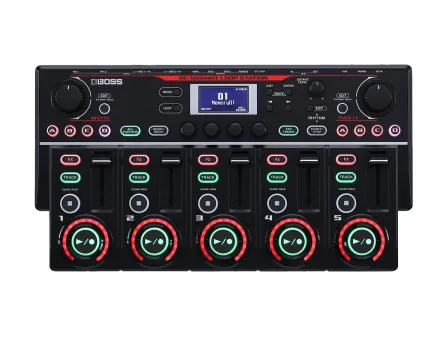
So there's that, and then, you know the Loop Daddy guy? I forget, he's known as Loop Daddy, I forgot his real name. I follow him. He seems like a wonderful person. So he uses the 505, the big looper, the 505 with five different things, and I'm like, well, my set-up is, first of all those are like $400, $500, right? So I'm always looking for something more like $100, or possibly $200. And so, they have the 202, the RC-202, is it Boss?
PC: I think so.
JK: Yeah, the Boss 202. And that fit my format better, because I was primarily relying on my setup being on the treadmill. And that worked out, that was fun, I was having fun looping, and I couldn't understand any of those buttons. But I would get some interesting sounds. So, but then about a year or two ago, that thing, I bought two of them actually, and after smashing them so many times, they just stopped, the button stopped working, it just didn't work. And then I picked up a Casio, again cheap Casios. Right now I don't have a Casio, I picked up a Yamaha.
PC: Yeah, a little PortaSound.
JK: Yes, from eBay. Another person sent me the drum machine, the 707.
PC: Oh yeah, yeah, the Boss 770.
JK: Right, DR-770. And I had to solder it, because it wouldn't stay on or whatever, so I just reheated the solder and that seems to work. So, stuff like that. And then I picked up a cheap switcher, so this is the little switcher guy, I'm able to plug all the sounds into that, or at least a lot of them. But I'm also relying on just individually putting these out onto little portable speakers. And so I could bypass the switcher altogether. And my latest thing I got is the Volca Keys. Yeah, I got that off Sweetwater.
PC: Nice, nice, shoutsout. [Laughs]
JK: Shoutout to Sweetwater. Stylophone sent me, they sent me a couple of Stylophones.
PC: Wonderful.
JK: So I have a couple of Stylophones. Some I mix and match. I was using the Akai, the MPK Mini Play. And in fact I think I'll bring that to Denton, because it'll fit in my carry-on. Whereas these will not. And a friend, an artist friend, she gave me the Micron.
PC: The Micron, legendary.
JK: That is an awesome beast. That is a tank.
PC: For me personally, as a little kid going to Guitar Center and stuff, I always was mesmerized by the Alesis Micron.
JK: Wow.
PC: Because it does have sort of minimal buttons, and you don't really have to know how to use it, in a weird way.
JK: You don't have to know how, and I again don't know how to use it, but I get some interesting sounds out of it. What I find too is when I get a sound, I want to try to possibly duplicate it, or at least stay there in that sound, but then also maybe move on. So, it's like painting. You're getting these various variables...
PC: Yeah, it's interesting how that comes out of your painting practice.
JK: In some ways I've even considered, forget about painting, just do this.
PC: Sure, sure. Before we started, I know you talked about how you find yourself going back and forth between the works you're making and also creeping back into music stuff.
JK: Well, Joni Mitchell, she famously does, she talks about how she performs, but then she'll shut down and go into the studio and paint.
PC: Interesting.
JK: So I was like, oh yeah, that's kind of what I do a little bit.
PC: It's fun how, obviously from our camp at Perfect Circuit, we get enamored with these instruments. I'm curious, I know I've seen you do some still life paintings with some of them. Are there pieces you have a particular affinity for, that you find yourself feeling, 'I love every time I come back to touch that thing'?
JK: Oh, shoot. Good question. I think I go back to just the piano keys. I love it. So maybe it's because I grew up with a piano, and I secretly just really like pianos. And in fact I was kind of imagining getting even a better quality piano, a synth piano type of thing, like Yamaha, they make the CP something. I've seen those, again, they're like 400 bucks. Or at least used. So, but anyway, I don't care for the pianos that have the little keys, they're problematic, because these little mini keys, they're shitty keys, there's no fun. Whereas the Micron, those keys are pretty decent. I don't know what type of key they are, but...
PC: Sure, sure. It's a better quality key.
JK: Definitely like that one more, but I don't necessarily have a favorite, in a way. I'm kind of in a weird way itching to play some guitar. Well, the whole world musically is totally there, they all make sounds, and you can do something with them, respond, react, respond, react to the sound.
PC: Yeah, I think that kind of materiality, so to speak, of the hardware instruments, whether it's a guitar or something else, is important. You were talking about not so much enjoying going back and forth with the computer, and I can totally feel that, being able to just touch and respond.
JK: And in fact, I'm not that happy with plugging everything in, and in that sense, just a regular guitar and... And I picked up this, what is it, a little mini xylophone thing.
PC: Oh yeah, a little glockenspiel guy.
JK: Yes, I can't say that. Wait, how do you say it?
PC: Glockenspiel.
JK: Glockenspiel, yeah. But those are fun.
PC: Yeah, you know, it's like you can make sounds out of anything. Pots and pans.
JK: I haven't gone that far.
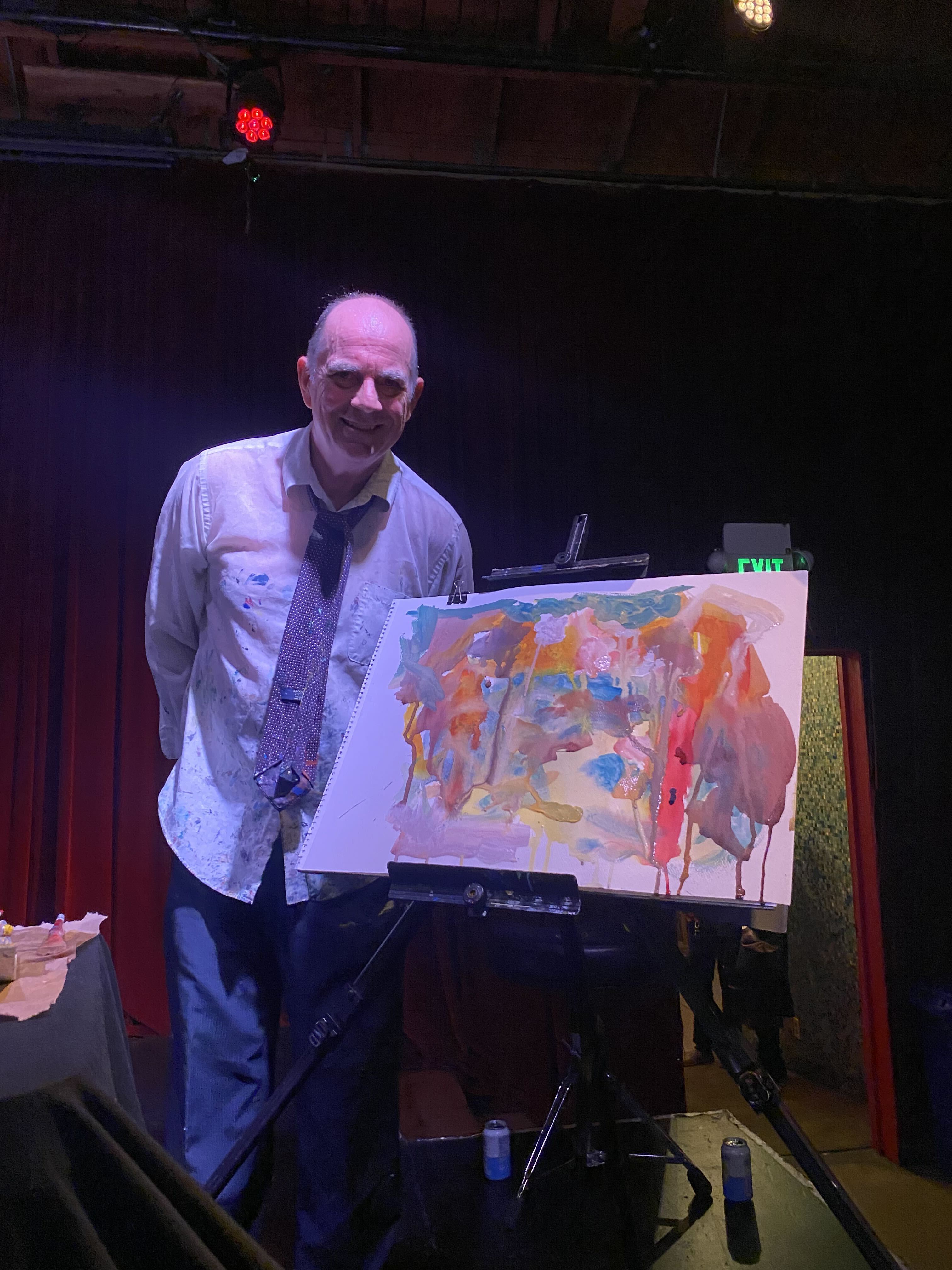
[Above: John proudly presents a painting made during his performance with Adam Lion at 2220 Arts and Archives in Los Angeles.]
PC: I saw you play the little glockenspiel at 2220 in Los Angeles recently with Adam Lion.
JK: Yes. Yeah, vibraphonist, free improviser. I was looking forward to doing that, because I know that's what he does.
PC: Totally, yeah, that's a great mix. How did that show come about?
JK: Well, he just contacted me out of the blue, I guess, on Instagram.
PC: Do a lot of people reach out to play with you?
JK: Off and on, it kind of comes and goes. Not a lot, but it does happen.
PC: I was struck, because when I first encountered you, I had explored some of the Let's Paint TV stuff back on YouTube, and had always enjoyed those videos. And then when I saw you on Instagram making music, some of my background is similar to Adam's, in the free improv world. And it struck me as, what you're doing really fits well within that world, and I thought the performance you two did together totally made sense within that little niche musical culture. Was that an area of music you were already familiar with, like noise music or improv music?
JK: Well, I've been invited to do those performances, which is crazy, because now I'm actually playing music, but at the time I was just being asked to do my treadmill thing, with the blended drinks and painting. But now I'm incorporating playing a piano or whatnot. There's a number of venues I've performed where I'm making noise, making sounds, like the High Zero Festival in Baltimore. That was a place where they pick three people out of a hat, and you arbitrarily have to perform.
PC: Yeah, yeah, improv lottery.
JK: Yeah, so that was exciting, that was exciting. And this place, the Electric Eclectics Festival. That's in Ontario. And again, collaborating with musicians, singing and stuff.
PC: And you're doing this show coming up in Denton, Texas, at Rubber Gloves. Which, we were talking about, I have some experience playing shows at, and wasting my teenage years around, or maybe not teenage years, it is a bar. That's exciting. I'm curious, is that something you're trying to do more of? Are we going to see the Let's Paint tour anytime soon?
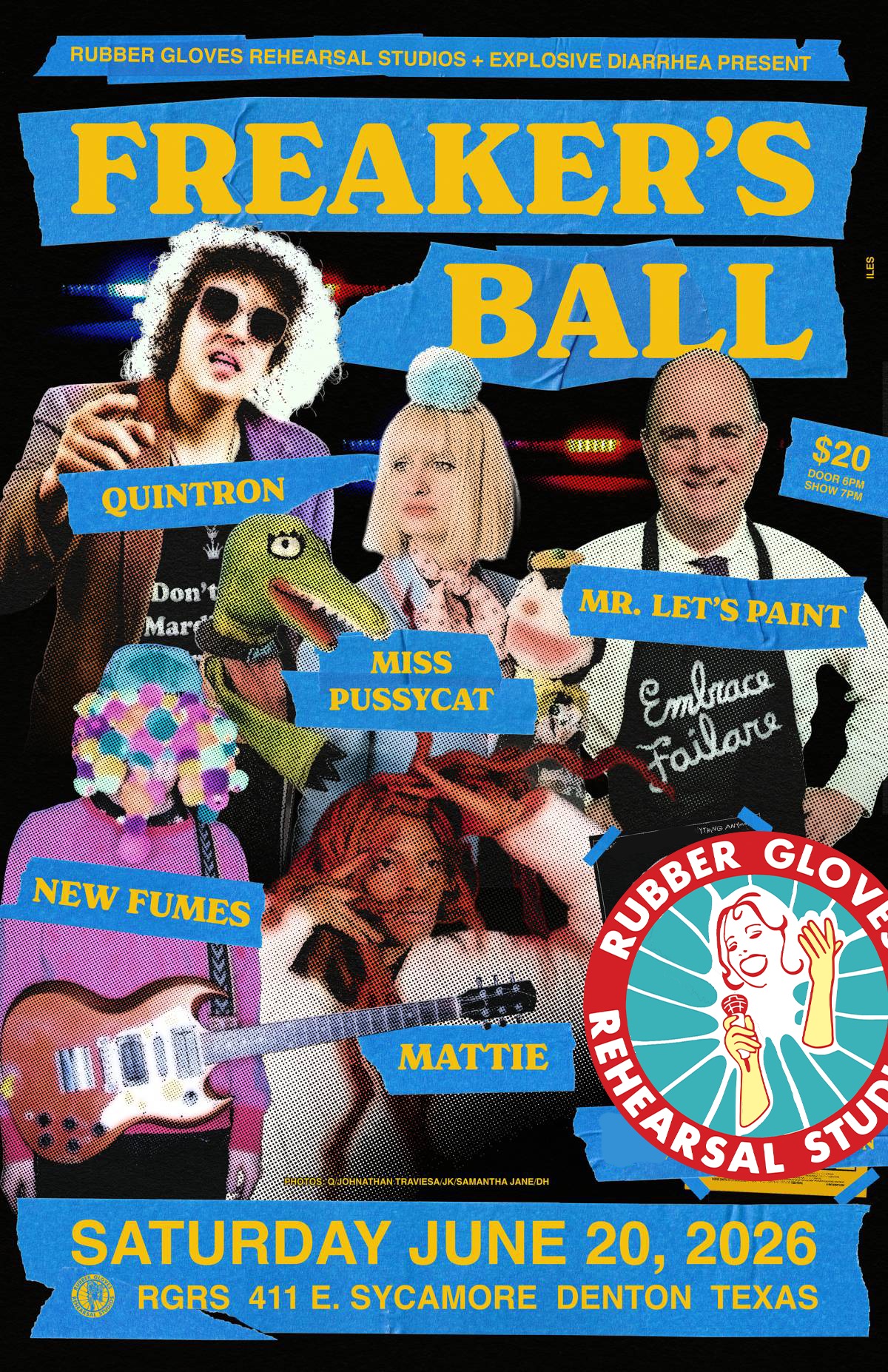
JK: Well, I mean, off and on I do the tour, off and on I get asked to do this. So it kind of comes and goes. Maybe it's because COVID, not much of anything was really happening. But I do get around, and I think prior to COVID I wasn't necessarily incorporating the music so much, I was really just being asked to strictly do the more treadmill work, if you will, the painting and motivational speaking kind of stuff, which I'm basically still doing. But with the music, I'm able to delve into that, and I'm kind of working my way into doing more of it.
PC: Are there musicians out there you'd want to collaborate with, that you've thought about, or reached out to?
JK: I mean, I'm open to it.
PC: A little John Bon Jovi collab?
JK: Maybe not. I mean, I don't know, it could work. I'm open to it, if it works, then it could be anybody, right, it could be anybody. I like the idea of it, though. I'm not really, I'm a little uncertain about how that works, in a sense, because I think I come to it with my own approach, so I would have to, maybe we'd have to figure out how to do it. Maybe put a little thought into it.
PC: I don't know, just a little bit, not too much.
JK: Because actually with Adam, we didn't even meet until we did that performance.
PC: Oh, really?
JK: Yeah, we didn't talk about what we were going to do.
PC: That's amazing.
JK: Yeah, so in that sense that was kind of ideal, because otherwise then you're planning, studio, band practice.
PC: Yeah, band practice, we all know that.
JK: I don't know, I mean, that, but it's important. I think that's more important for the more poppy, planned... presentations. But the beauty about experimentation is that it is exactly that, and it's all about the moment, that time and space. And just kind of figuring out how to get through it in a way, but also, you know, make some sense of it.
PC: I mean, there's something about improvising music, something you said earlier reminded me of, where you were talking about content creation, how if you just go at it for a while, there's definitely going to be like a little 30 second chunk that's really amazing.
JK: There really can be.
PC: And I think in some of that work it definitely seems like you've been able to tap into that. Going through that process of finding those moments, and then also finding those moments where it's totally not working, and there's something kind of beautiful about that too, I think.
JK: Well, yeah, and then, the problem I think too is you're not always aware of what it is. So I think that's, that's a problem. And then it's just a technical thing, like in my case, sometimes I lose a lot of stuff just because my mic isn't working. I have it where I just use this USB mic, one mic, coming off these speakers, there's no sound system. And I wouldn't know how to use one anyway.
PC: I was curious, I know you have some recordings on Spotify since 2023. Was that all DIY, done yourself and recorded? And those are all just sort of live takes, basically recorded here?
JK: Yes, I think they're all that way.
PC: Have you ever considered going into a studio, kind of similar to the public access, and having other people run the knobs for you?
JK: That would be fun, but I wouldn't know how, it seems like that would cost money or something. Like, I'm not doing that. But I'm hesitant, I think it's because I'm somewhat of a cheapskate, and I've survived this long being an artist because of that.
PC: No, totally, you get a lot of freedom doing stuff yourself too, I think.
JK: Yeah, I guess. But I welcome that idea, I'm just not inclined to be paying for it. I'm hesitant on that.
PC: What's the best place for people to check out what you're doing, stuff you've made, either sound or painting?
JK: Instagram is probably my best spot, that's where I've been putting most of the music, the clips. And then I sell a lot of my work on Etsy.
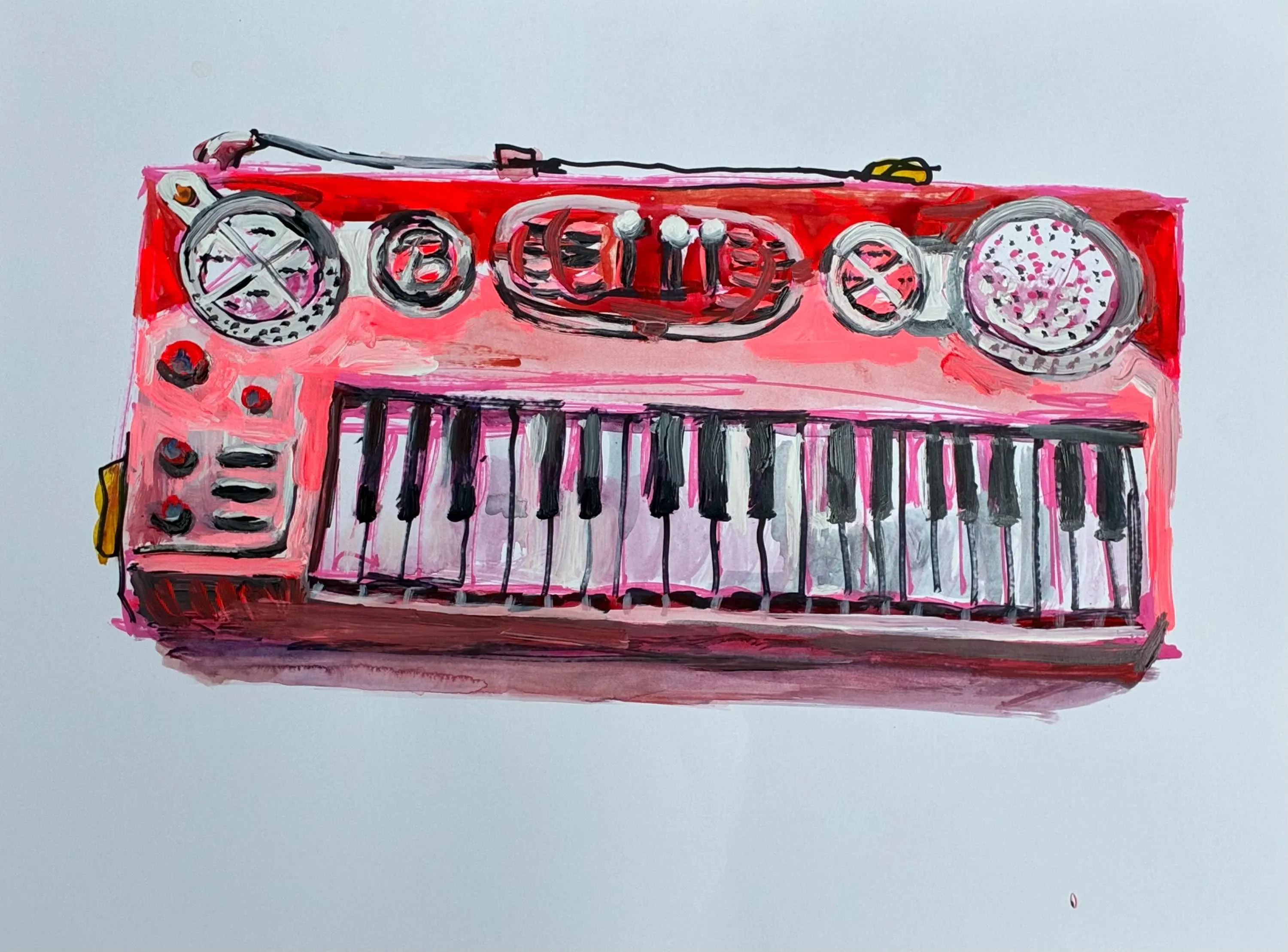
PC: Yeah, definitely hit up the Etsy store. Some great synthesizer paintings and more. Some great stuff on there for sure.
JK: Yeah. And then I got the YouTube channel, that's where I do the live film and that, but I'm also doing live on Instagram too, at the same time.
PC: Right, right, awesome. Well, thanks so much, John, for having us out.
JK: Yeah, thank you for coming. I'll have to come visit the store.
PC: Yeah, come down, make some sounds with us!


The information below is required for social login
Sign In
Create New Account