I first encountered the quizzically named Vhikk X last September at the Machina Bristronica synthesizer festival in Bristol, UK. I’d been told I needed to check it out, so I spent a few minutes chatting with the Forge TME designer, Fletcher, who said many things about algorithms, vortices, alternate realities, pulsating artifacts, sonic planes, and diabolical networks. I wasn't really comprehending much of what he said, and it was difficult to appreciate what the module was generating in the frenetic noise of the Bristronica main hall. Still, I was struck by the comments of a few people who lurked nearby. Some remarked, "Oh, there it is, it's wonderful!" Whereas another cut in to tell Fletcher how amazing the module was and how they have to get another one. There was an unusual buzz around it that I didn’t quite understand at the time.
Since then it's become something of a legend. I know a few people who have one and really relish it as a source of soundscapes and weird occurrences, and I know plenty more who are eagerly awaiting the next batch as there never seems to be enough to go round.
When a module gains a certain mystical reputation for reasons that aren't entirely clear, I find my cynicism gets triggered. Combine that with esoteric website copy and the fact that the labels on the knobs don't really tell you anything, and I personally start to lose interest. However, a friend told me not to knock it until I'd tried it, and lent me his, so I've had the opportunity to spend a bit of time in the warm embrace of its electronic convulsions. Much to my disappointment, this thing named Vhikk X (which I think people simply call "vick"), is almost every bit as extraordinary as people say.
So What is Vhikk X?
To cut through the waffle and fanciful descriptions, Vhikk X is perhaps best described as a wavetable multi-oscillator fused with a DSP effects engine. There are a number of algorithms that rewire internal structures, redefine oscillator components, and remix processing. The algorithms then spin out various parameters into an array of knobs and encoders, giving you playful access to sound generation and tonal sculpting. The result is a sound that's difficult to pin down. Every twist and turn seems to pull it further from normality. Tones fly, pitches dive, harmonics resonate, and waves crash upon the shoreline of an ocean of sounds—it's as if there's no end to it.
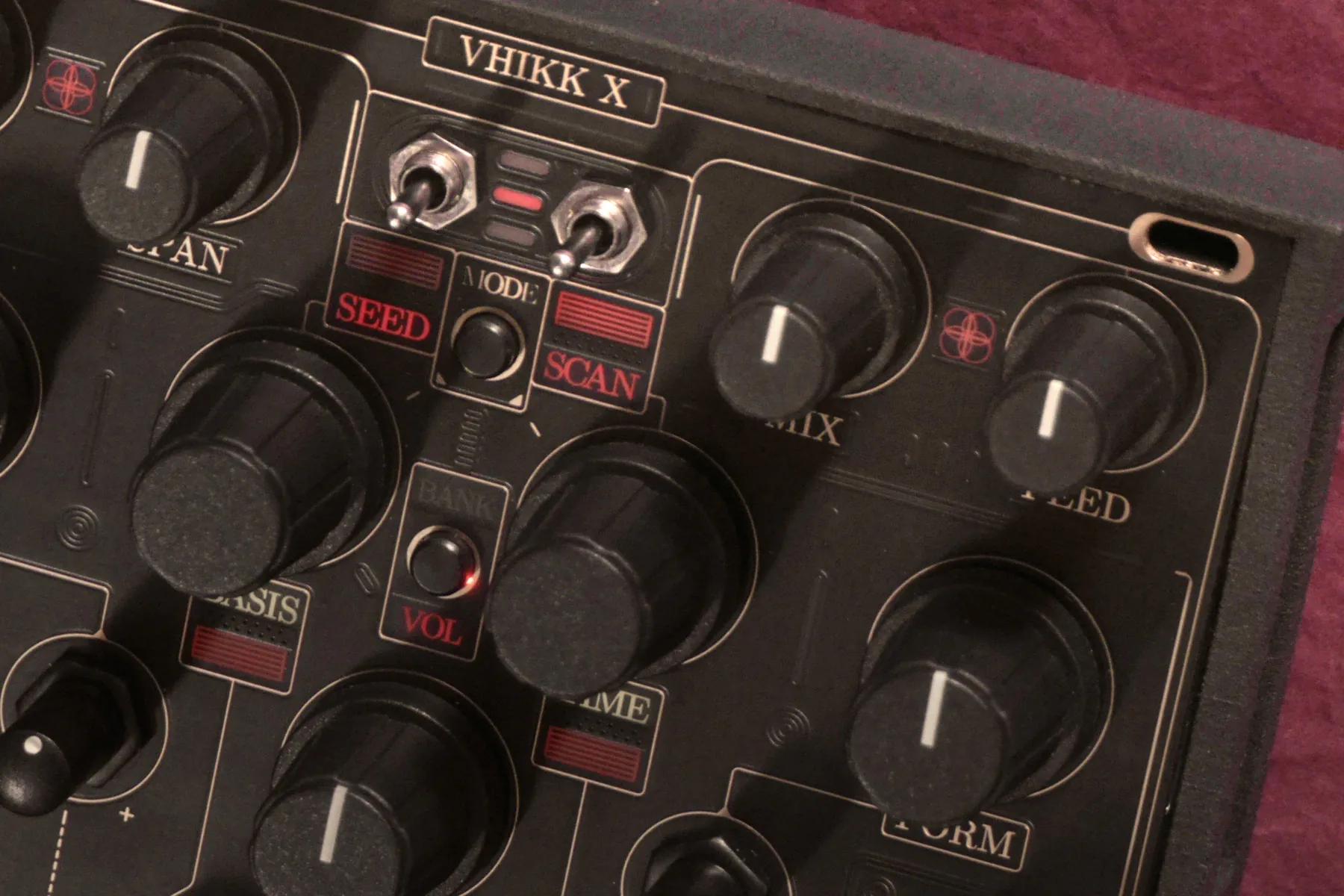
Starting with the most basic algorithm, it's possible to find a regular melodic, virtual-analog sound source and then work your way through the module to discover its features. Vhikk X has two main sections. On the left are the oscillator controls; on the right, the effects controls. The oscillator starts with the Basis encoder, which controls the fundamental pitch. The Span control augments that by detuning or shifting the pitch of the second (or more) oscillator. Morph tends to scan you through the loaded wavetable whereas Warp will do something weird. In this first algorithm, it will cross-modulate to the two oscillators if you turn it right, or introduce ring modulation if you turn it left. Fuse likes to straddle the sections and interfere with other parts of the module. In this case, it can add chorus if you go one way or push into the resonance of the filter if you go the other. The controls will vary depending on the algorithm, and it’s probably a good idea to keep a cheat sheet to hand. Although it’s probably more fun just to turn things and go with whatever happens.
×
The filter can be found behind the oddly named "Field" knob. It's really a DJ-style filter that is high-pass to the right and low-pass to the left. With a sequence patched into the Basis input and an envelope pumping into the Field input, you can pretend Vhikk X is a well-behaved and quite juicy dual analog oscillator, but it won't let you stay like that for long.
Which brings us nicely to the effects. Currently there are two effect engines working within the nine algorithms that come with the Vhikk X. One is called the Dungeon Metallic Delay/Reverb and the other is the Reflekta Diffuse Delay Structure. With the Dungeon, you get a rather nice transition between reverb and delay via the Form knob. Turn to the left, and it delays; fall to the right, and it digs into space and reverb. This is tied to the Time encoder, which fiddles with the delay and decay times. As an encoder, you don’t really get a sense of where you are, and so it’s more playful than accurate and confusingly dependent on some other factors. The Mix and Feed (feedback) knobs are probably the only clearly labeled controls on the whole module and actually do what you expect them to. And then you have Cell, which shifts the pitch in strange and unnerving ways. The Reflekta offers something different, something that I couldn't quite wrap my head around in the way you can with a regular delay. It was noisy, bruising, unbending and rude - or maybe that's just me.
You can use the effects on their own and apply them to external sources if you so wish. To remove the internal sound engine from the equation, spin the Basis encoder until the pitch is so low it disappears. Although there's no reason why you can't blend the two, the input with the internals. If you press the Bank button, the two encoders become volume controls over the input and output levels to help with the balance.
The Vhikk Experience
×
It all appears relatively straightforward until you are inevitably tempted to move a knob. There's something uncanny going on in how the various controls and structures interact with each other. You'd think that moving something would have a small impact that can easily be reclaimed, but instead it's like poking a waiter carrying a tray of drinks on a unicycle, on the deck of a boat, on a roaring ocean. Things start to cascade, first with little tiptoe movements and then with wild lurches. You reach for another control to compensate, but it overcorrects, sending something spinning to the floor, while the intensity ratchets up in the background. You throw a switch and sound gets pulled backward through a portal to another space, and your melody disappears amongst the metallic scrapings of waveforms meeting solid objects in a shower of sparks.
Vhikk X has the ability to suck time out of the room as you become thoroughly engrossed in the ebbing and flowing of sound, texture and timbre. And just when normality is close, you can punch the Mode and Bank buttons to scatter the controls into randomization and begin once again to strip away at reality. It's an extraordinary module!
With such change available in the turn of a knob, it makes sense that Vhikk X would enjoy a bit of modulation. For this, everything has a CV gateway. Interestingly, there's a built-in VCA which you can use to formulate textures into definable bleeps and bloops. But the VCA input is also normalled to the five main controls of Morph (waveform), Basis (pitch), Field (filter), Time (effect time), and Form (effect shape), so that anything you plug into the VCA is carried to all the other destinations. This can be the cause of some very unintentional agitation. However, you can break these connections by patching something else into the next input or just leave a cable hanging.
×
At the time of writing, the Vhikk X ships with 9 algorithms, largely based on the original Vhikk. They start with the basic two-oscillator analog-style and then quickly descend into various combinations of cluster oscillators, wavetable scanning, phase modulation, frequency spreads, and bit crushing. At Bristronica, Fletcher said that more algorithms would be available shortly, with potential for 34 coming along any time now. It's been 9 months, and the algorithms remain the same, which is disappointing. However, what we have in the original 9 is sublime. A fascinating combination of things that makes each one a unique starting point for exploration. They have a similar vibe, which, I feel, defines the Vhikk X somewhat and makes it recognizable in a mix of sounds. While there are endless tonal combinations to explore, it would be good to have a definite new direction.
In my time with Vhikk X, I took it from a very pleasing and lively virtual analog synth voice into realms of texture and adventure that I could never have predicted. In fact, to say that I had anything to do with it is stretching it a bit. It takes on impossible corners, it flips, performs magic, and then swishes onto another destination while you hang on for dear life. There's something in the way Fletcher has massaged the algorithms that makes it feel so lively, so full of possibility and how every change takes you somewhere interesting. Some things are obvious, like how you can push the effects mix and wind the feedback up to the max to start building something ominous, but then why does Cell feel like it's throbbing through the harmonics, while Warp is tinkering with the distortion? I'm not sure it was doing that before. It's brilliantly curated unpredictability that will wait for you to catch up and then leave you in the dust.
You could score a whole movie by setting it in motion and interacting with the knobs. It will produce drones, soundscapes, cinematic thumps, unexpected cascades that morph into waterfalls and then find a melody emerging from the chaos. If you need a safe, predictable, repeatable sound source then Vhikk X is not for you. But if you want to leave your expectations behind and enter into the adventure, then, if you can find one, grab hold and don't let go.




The information below is required for social login
Sign In
Create New Account